Category: Employee Medicals

  • On-Site Medicals

    On-Site Medicals

    The Benefits of On-Site Medicals

    on-site medicals
    on-site medicals

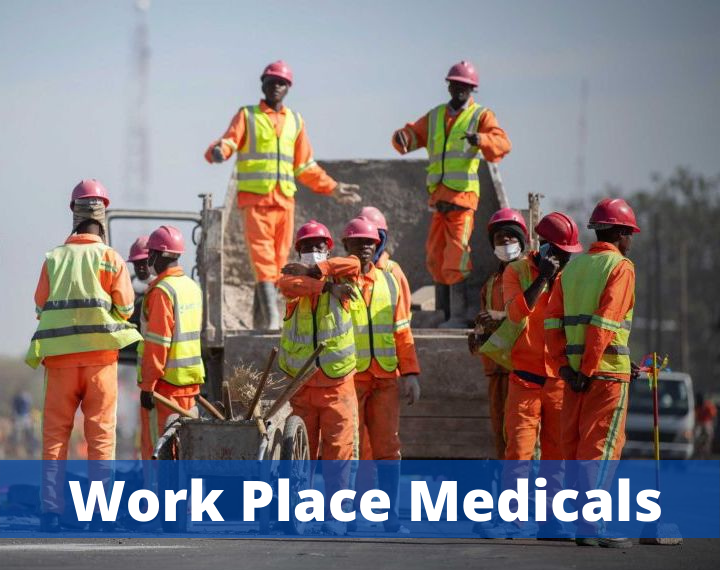
    On-site medicals provide the business owner and employees with a wealth of benefits. For starters, the employees don’t have to worry about transport to the clinic (and the associated cost) as they can just attend work as per usual. The tests are carried out swiftly and meticulously, and the results thereof are kept private. When dealing with our team and ordering on-site medicals, you can expect us to have the utmost integrity and discretion.

    On-site medicals can be used to monitor the effect the working environment is having on an employee’s health. The tests include testing for toxicity, as well as hearing, eyesight, stress, and more. If there is a specific test that you would like carried out, simply let us know and we will do what we can to assist you.

    On-site medicals can help you ensure that workers are provided with prompt medical care when required. It can also help you to understand the negative effects of the work environment, and help you to set mechanisms in place to protect the health and safety of your workforce. By monitoring an individual’s health status, you can also avoid potential litigation brought about by disgruntled employees whose contracts are terminated. In many respects, on-site medicals will help you to protect yourself, your business, and your employees.

    It is important to book your occupational medicals with a team that has experience in your industry and knows what the legislation and regulations demand. At FITMed24, we are familiar with the requirements in most industries and can help you to simplify the process. We apply our knowledge of each industry and use the data provided by you to ensure that your business is compliant at all times.
     

    On-Site Medicals Available for all Industries

    Whether you work in the mining industry, production and manufacturing industries, or food-handling industry, on-site medicals are an absolute must. In fact, they cannot be avoided, as non-compliance can result in a hefty fine and/or the business being closed permanently or for a certain period of time. At FITMed24, our medicals currently start from as little as just R320, so there is really no excuse. Now occupational medicals are an affordable endeavour for all.

    If you would like to book regular on-site medicals for your business and ensure that you are compliant with the legislation and regulations in your particular industry in South Africa, we recommend that you get in touch with us directly.
    You can reach us by email or telephone during office hours.

  • What are Occupational Health Services and Why Are They Important?

    What are Occupational Health Services and Why Are They Important?

    Health and safety, industrial, or occupational hygiene are all terms that are so frequently used interchangeably that it is easy to overlook the fact that they refer, not to a single science, but to a combination of many. One thing they all have in common, however, is that their aim is to ensure the physical and mental wellbeing of employees in the workplace. It is convenient to categorise their various efforts as either technical or medical, and it is the latter that may best be described as occupational health services.

    It is the technical experts who are tasked with identifying any hazards that might pose a threat to the safety or wellness of employees. However, the responsibility for determining whether employees may have been affected by such hazards, or that they are sufficiently fit to perform those tasks that are expected of them, falls upon doctors, nurses, and other healthcare professionals with the necessary experience to provide these specialised occupational health services.

    Every job poses its own challenges, some of which may be physical. Where this is the case, not everyone who applies for the job is necessarily capable of meeting its challenges. Consequently, one of the more common requests made to these specialists is to conduct a medical examination specifically designed to confirm or preclude an applicant’s physical suitability for a given job.

    Among the many industries in South Africa that now depend on these assessments on those organisations qualified to provide occupational health services are mining, construction, aviation, and haulage, as well as those employers involved in the preparation and production of food and beverages. The latter group is interesting in that it is the employee rather than the job that might pose a potential hazard. Their noses, mouths, and other sites must be swabbed and checked for the presence of pathogens, such as Salmonella and Staphylococcal species that could contaminate food and infect consumers.

    The need to perform these cultures and any other laboratory tests that may be appropriate requires companies engaged in dispensing occupational health services to provide the necessary facilities and to employ suitably qualified staff to perform them. These services, incidentally, may not be limited to conducting medicals and lab tests.

    Educating employers and employees about how to conduct their own safety measures can be every bit as important. This is why, FITMed24, one of South Africa’s leaders in this field, has added a number of valuable SETA-accredited training courses to its extensive portfolio of on-site and clinic-based occupational health services. Courses cover knowledge of basic first aid and fire fighting, evacuation and emergency drills, as well as HIV and TB in the workplace.

    Contact us today for more information

  • THE IMPORTANCE OF OCCUPATIONAL HEALTH

    THE IMPORTANCE OF OCCUPATIONAL HEALTH

    Why is occupational health important? Anyone who is employed will know that the job can get on top of one at times. However, it may not be the job itself or any lack of knowledge or experience that is the problem, but rather that you simply lack the physical qualities required to perform certain of the tasks required. The science of occupational health (OH) was born as a result of health and safety legislation governing the management of potential hazards in the workplace. While the legislation proposed the introduction of measures to protect workers from such hazards, this invaluable spin-off of the Health and Safety at Work Act is intended to measure the fitness of individuals to perform their various assigned tasks.

    For example, someone with respiratory problems should not be working in an environment where sawdust or cement particles are constantly present in the air, even if provided with a protective mask. Likewise, that same employee could be at risk if consistently required to lift heavy items. Examination by an occupational health specialist can quickly expose such inadequacies and ensure that those affected are allocated tasks that they are physically capable of doing.

    For several years now, this type of examination has been seen as a valuable addition to the conventional selection process. In addition to the usual reference checks, psychometric tests, and face-to-face interview, many prospective employers are now choosing to include a medical examination, more specifically, an examination of the type conducted by an occupational health specialist. These are essentially a means by which to gauge whether a candidate has the level and type of physical fitness seen as necessary to cope with the physical demands of the job rather than merely possessing an appropriate qualification and a glowing reference.

    These procedures are thorough and can be tailored according to the specific needs of given industry whilst containing elements that remain common to all. Furthermore, the value of this particular type of occupational health service is not confined to recruitment. Anyone who is engaged in a physically demanding task, for a protracted period, carries the risk of an injury or illness that might require time off from work. For these individuals, an OH specialist will be far better qualified to determine whether or not they are fit to return to work than the average GP who will probably have little knowledge regarding the physical demands posed by the patient’s job.

    Despite the importance of these medicals, this is only one of the services provided by occupational health specialists. In addition to being called upon to conduct TB and HIV screening programmes, they also play an important educational role. For example, companies are required by law to ensure that adequate first aid facilities are available to their staff. The kit alone, without the knowledge and experience needed to utilise it, would be of little benefit, and so, these specialists also undertake to provide all of the professional first aid training required.

    In order to gain employment as an occupational health practitioner, the doctors, nurses, and other healthcare professionals who choose this option must undergo a course of specialised training, gain a recognised OH qualification, and be granted official accreditation before they are permitted to dispense their professional services. Chat to FITMed24 about OH services for your staff.